Solonis B destruction
Gate CrashersSolonis B destruction is the geocidal catastrophe that exposes the lethal consequences of the galaxy’s attempt to study humanity from a position of control. The world known to humans as Solonis B and to the wider civilized galaxy as Culpus-Alam was not an ordinary inhabited planet: it was an Assembly research site containing human communities whose ancestors had been taken from Earth. When the planet was destroyed, the surviving human investigators were treated as suspects, the catastrophe became the legal basis for a retaliatory strike against Earth, and the struggle to establish responsibility became inseparable from the question of who had the right to possess, observe, and judge the displaced population.
An Engineered Human World
Culpus-Alam had been set aside many generations earlier as a controlled experiment in human development. Vel Noric watched the human vessels depart from the planet and understood that the experiment had run unattended for many cycles while its isolated populations developed distinct cultures. The intended next stage was to bring those groups into contact and observe their interactions, producing knowledge that might help the Assembly predict humanity’s eventual integration into galactic society.
The human inhabitants were not indigenous to the planet. The Assembly later explained that the base populations had been taken from Earth, with isolated tribes preferred for the experiment and a random sample added to reduce the dangers of inbreeding. That disclosure radically changes the meaning of the destruction. Culpus-Alam was simultaneously a human homeland in lived experience, an Assembly possession in law, and a scientific enclosure created through forced population transfer. The humans encountered by the expedition, including the visibly human woman who emerged from the foliage with a blowgun and blue-and-white body paint, were not an alien species but descendants of people relocated for observation.
The experiment was also shaped by the Assembly’s uncertainty about humanity. Its members had monitored Earth broadcasts but found them contradictory: some depicted humans cooperating with other species, while others showed humans and aliens destroying one another. The decision to construct an off-world experiment was an attempt to resolve that contradiction through controlled observation. Culpus-Alam thus embodied a profound asymmetry: the Assembly claimed to study whether humans were noble, tolerant, irrational, violent, or bigoted, while denying the observed population an equal role in defining the terms of the study or the status of its world.
The Destruction and Its Scale
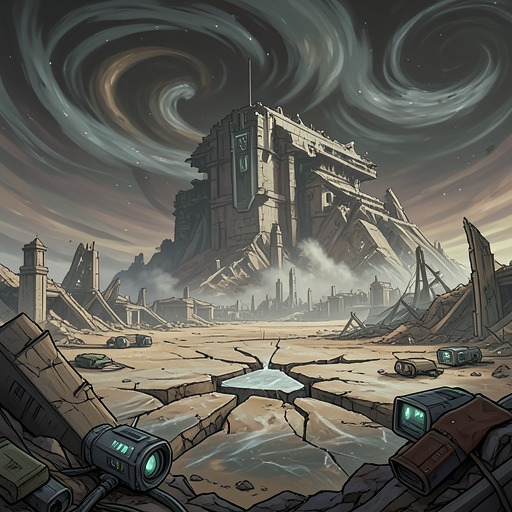
The immediate experience of the catastrophe is presented through D’armic’s encounter with an impossible phenomenon in high-space. Ahead of his cutter, a titanic worm of fire twisted through the vacuum, boiling along its surface and ejecting fragments larger than the ship. His lower brain interpreted it as a monster from ancient Lividite superstition, and the cutter’s emergency response opened a portal back to the universe below. Only after reaching safety did D’armic examine the sensor records and recognize that the fire worm’s estimated mass matched, to six decimal places, the mass missing from Culpus-Alam.
The discovery connects the terrifying apparition to the physical destruction of the planet. D’armic realizes that the monster was not a myth rising from his people’s imagination but the visible consequence of a planetary weapon. The book’s disaster imagery makes the scale almost impossible to comprehend, yet it grounds the revelation in an exact sensor comparison: the missing mass is not an impression or rumor but a measurable signature of geocide.
The method has a historical precedent in the Lividite war against the Pu’Lan and other opponents. When the Lividite war machine overreached and the Pu’Lan inflicted a series of unprecedented defeats, the Lividite military sought to make an example of them. A ship could fly directly at a world, open a high-space portal, and allow the resulting tunnel to bore through the planet. When the magma tunnel collapsed, the consequences included immense volcanic eruptions at the entry and exit wounds, shattered tectonic plates, disruption of the planetary core and magnetic field, and the ruin of the surface. Solonis B destruction therefore belongs to a known tradition of technologically simplified but morally catastrophic planetary violence: the mechanism is straightforward precisely because the perpetrators have abandoned remorse.
The False Accusation and the Political Crisis
After the destruction, the human vessel Bucephalus becomes central to the accusation. In the Assembly hearing, human representatives insist that an entire planet covered in dead humans gives them authority to demand answers, even though the world is claimed as Assembly territory. The dispute is sharpened by the fact that the humans on Culpus-Alam existed there only because the Assembly’s people had kidnapped or removed their ancestors from Earth. The legal argument over jurisdiction consequently conceals a prior act of appropriation: the Assembly treats the experiment as its world while the victims’ descendants experience it as their home.
The accusation against the humans is powerful because it is attached to a planetary death. The prisoners are described not as hostages but as suspects in the destruction of Solonis B, with a formal trial promised in due time. This distinction allows the Assembly to present its detention as lawful procedure while the human side sees the process as part of a larger effort to shift responsibility away from the actual perpetrators. The name itself becomes contested: Bloon asks what Solonis B is, and D’armic explains that it is the human name for Culpus-Alam, revealing how even the planet’s identity has been divided between institutional and human vocabularies.
D’armic’s testimony begins to break the official account. He states that his evidence is physical and that it caused him to turn his investigation away from the humans. More specifically, he argues that Bucephalus is physically incapable of creating high-space portals large enough to destroy Culpus-Alam, Okim, and Kulla. By contrast, the patrol cruiser commanded by the deceased Vel Noric possessed the relevant capability. The claim implicates a figure already associated with the research operation and turns the investigation from a question of human aggression into a possible case of state violence and deliberate concealment.
The Assembly’s resistance is immediate. Ruckk rejects the idea that a Vel could have ordered geocide and accuses D’armic of using the charge to cover crimes committed by the humans and their alleged coconspirator. D’armic answers that disbelief does not alter physical truth and points out that the Assembly has as much incentive to suppress the evidence as the humans would have under reversed circumstances. The hearing therefore becomes more than an inquiry into one destroyed planet: it tests whether an institution built to classify and manage other species can investigate its own military power without protecting its hierarchy.
Retaliation Against Earth
Solonis B destruction produces an imminent threat far beyond Culpus-Alam. The human delegation tries to prevent a retaliatory strike against Earth by presenting evidence that exonerates its forces and demonstrates that they were framed. Before the delegation can arrive, however, the attack is launched. The report reaches Eugene with the warning that the strike could occur at any moment, converting the political dispute into a countdown toward another planetary catastrophe.
The sequence places the destruction of Culpus-Alam within a chain of escalating violence. A world populated by displaced humans is annihilated; the survivors or rescuers are imprisoned; the accusation is converted into a legal justification for punishing Earth; and the threatened punishment proceeds before the evidence can be heard. The catastrophe is thus both an event and a weaponized narrative. Whoever controls its official explanation controls the legitimacy of the next act of violence.
The book repeatedly sets immense danger against ordinary or absurd human details. Felix studies the cultures of the Pirikura while eating kuluk, a local animal called “chicken” that tastes nothing like chicken, and the expedition’s exhausted personnel continue to navigate bureaucracy, fieldwork, and personal fear while planets stand at risk. Allison’s insomnia later gathers together firefights, captivity, threatened torture, witnessing a planet’s death, and the unresolved danger to Earth. These juxtapositions do not reduce the catastrophe; they show how planetary destruction enters consciousness through fragments of administration, appetite, fatigue, and delayed terror.
Meaning and Narrative Consequences
The destruction of Culpus-Alam exposes the contradiction at the heart of the Assembly’s anthropology. It wanted controlled evidence about whether humanity was fit for galactic society, yet its own practices involved abduction, isolation, possession, and potentially geocidal violence. The human communities were observed as specimens while their history was managed by outsiders. Their existence becomes legible to galactic authorities as an experiment, but their deaths do not automatically grant them jurisdiction over the world they inhabited.
The event also makes evidence itself a battlefield. D’armic’s sensor analysis and the technical limits of Bucephalus challenge a politically convenient accusation, but the physical proof is initially less powerful than institutional disbelief. The Assembly can dismiss testimony as self-interest, redefine names, invoke jurisdiction, and characterize a demand for accountability as an offensive charge. The catastrophe’s truth is therefore endangered not by lack of evidence but by the ability of powerful institutions to decide which evidence counts.
Finally, Solonis B destruction foreshadows the wider danger of planetary weapons. The later sight of a gargantuan red-hot inverted cone rising beyond the horizon and the emergency attack involving a 32.4-terawatt particle beam extend the book’s scale of destruction from one experimental world to the survival of Earth and other planets. The decisive significance of Solonis B lies in this progression: it is the crime that reveals how easily scientific observation, territorial law, and military retaliation can merge into a system capable of treating entire human populations—and entire worlds—as expendable objects.